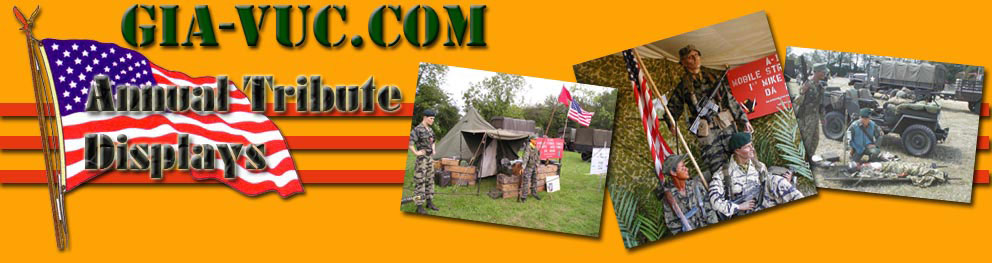
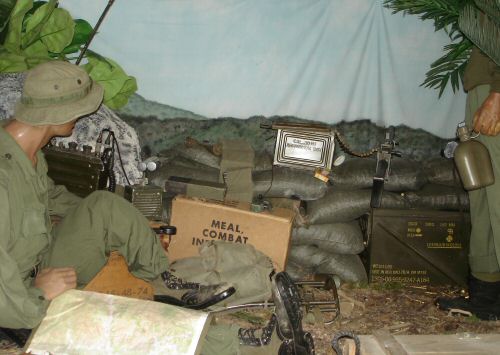
The 2008 “Gia Vuc Tribute
Display” is an integral part of Rolling Thunder 2008 Vietnam Living History
exhibition and his dedicated to US Special Forces Medal of Honour winner,
1st Lieutenant George “Ken”
Sisler.
The theme of Gia Vuc static
display is the highly classified
US SOG radio relay site “LEGHORN” in south eastern Laos.
US Special Forces Recon Teams
primarily operated in secrecy inside Cambodia and Laos where the Ho Chi Minh trail
was supposedly out of reach of US troops.
Once
over the fence, the US recon Team had to rely on
radio for support or extraction, clear communication with their forward
observation bases inside Vietnam were vital as well as often
difficult. They had to rely on covey riders (Forward Air Controllers in small
observation aircrafts) to often relay messages; so, possible radio relay sites
where looked for.
1st Lt G Sisler
(Recon team Colorado) had noted a fairly inaccessible peak in South Eastern
Laos which would make an excellent radio relay site for the teams operating in
that region. To test the feasibility of his idea, Recon Team Colorado led by 1st Lt G.
Sisler was inserted on the top of that peak by helicopter in January 1967. They were not expected to stay more than 7
days if that and were asked to take (deniable) WWII weapons in case they were
overrun.
After setting up
their two PRC 25 radios they were able to send and receive clear radio signals
between the teams in Laos and the FOB at Kontum, South Vietnam, therefore providing 24 hours radio support to SOG
teams in Laos. As the North Vietnamese’s forces became
aware of the team presence and they try to dislodge them, Team Colorado soon
fortified the pick with sand bags, mines, and barbed wire and an helipad was
also created near by as any supply or reinforcement had to be flown in.
The
site received the name of “Eagle Nest” which was very soon changed to LEGHORN, it was situated on a very narrow ridge some
1000 feet above the valley floor in the Attapeu ProvinceofLaos.
It was
hard to get not having any trails from the valley floor up and was hard to hit
with mortars because of its narrow width. It remained under American hands until the end of the
war and its radio call sign was “HEAVY DROP”Leghorn was also known as GOLF-5.
Later on the site would house POLARIS II state of the art National Security Agency radio scanning device allowing the Americain to monitor
hundreds different frequency as well as a radar guidance system. In fact
SOG-NSA radio would intercept/monitor a tremendous
amount of NVA radio traffic as well as hear and see NVA truck traffic moving
down on a major part of the Ho Chi Minh Trail network. Almost overnight Leghorn became a “must-see” for
passing US aircraft which used to sneak up at low level and then kick the
afterburners and flash pass low overhead. This was also a place for aircrew to
bail out where their distress signals would be heard. The site was abandoned in 1972 and heavily bombed by
US aircraft to destroy it.
NSA National Security Agency: US Organization responsible for monitoring,
intercepting and code breaking enemy signals
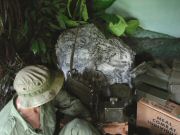
The recreated scene show one US and one Montagnard member of team Colorado. This is towards the end of their 10 days
stay on Leghorn as M16 assault rifle and M79 grenade
launchers have replaced the WWII M1 carbines.
Fortifications are at their enfant stage as a sandbag bunker complex with
trench lines will be established later on. The SOG members wear a plain
unbadged green jungle uniform (common in the early days), a PRC 25 and
assortment of US equipment can be seen, this scene has been recreated from original photgraphs.
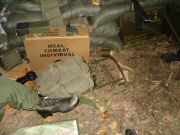
Photo of the display, not an easy scene to recreate, as this would have been on the top of a mountain. To give an
illusion of height, I got a big white sheet which was
dyed light blue then clouds
and a ridge line was painted on it. The big boulder seen on the photo was
scratched build from cardboard boxes,
polystyrene and paper Mache, the lot was given a texture and painted and weathered. The ground was a mixture of real earth and debris
I got from a local wood as well as plastic jungle foliage bought.
The recreated scene show one US and one Montagnard member of team Colorado. This is towards the end of their 10 days
stay on Leghorn as M16 assault rifle and M79 grenade
launchers have replaced the WWII M1 carbines.
Fortifications are at their enfant stage as a sandbag bunker complex with
trench lines will be established later on. The SOG members wear a plain
unbadged green jungle uniform (common in the early days), a PRC 25 and
assortment of US equipment can be seen, this scene has been recreated from original photgraphs.
First Lieutenant George “Ken” Sisler took
over Spike Team (Recon Team) Colorado in November 1966. A few weeks
after establishing LEGHORN radio site, 1st Lt
Sisler volunteer as a “straphanger” on a combined Hatchet Force operation in Laos.
“Lt.
George “Ken” Sisler was leading a patrol deep in “Indian Country” on February
7. 1967. While on patrol, his platoon was ambushed by a company sized enemy
force. “Ken” deployed his men for defense and called for air strikes. Being the
leader, Ken rallied his men and shouted not only orders, but also encouragement
to his men. Two members of his patrol were wounded by enemy gunfire. Without
hesitating, Ken left his platoon and ran back to his wounded men while under
enemy fire. He grabbed one of them and started carrying him back to the
perimeter when he again came under increased enemy gunfire. Ken laid the
wounded man down, grabbed his rifle and killed three of the charging enemy
soldiers. He then threw a grenade, knocking out a machine gun nest that was
firing at his men. Ken ran back to the wounded man and dragged him into the
perimeter. By this time, the enemy was attacking the left side of the position
and several more men had been wounded. Without
hesitation, Ken grabbed several grenades and charged the advancing enemy force.
He kept throwing grenades and firing his rifle at the oncoming enemy. His
action caused the enemy assault to falter, and they began to break off the
attack and withdraw. He continued to move around the area, directing his men in
the defense of the perimeter and calling in more air strikes on the enemy as
they left the area. During the final phase of the battle, Ken was hit by enemy
gunfire and mortally wounded.”
1st
Lt. George Kenton Sisler was posthumously awarded The Medal of Honor on June
271968.His medal was presented to George's
wife, Jane and his two sons by Secretary Resor on behalf of the President
of the United States.
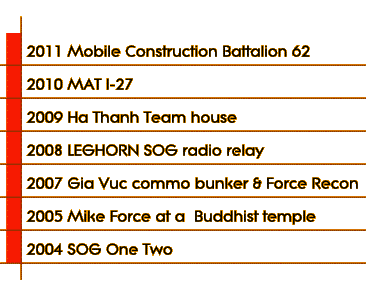
VISIT THE PAST DISPLAYS
Steve Sherman the
archivist for
the Special Forces and Special Operations Associations
Need your help!