The
Tropical Combat Uniform was patterned
after the 1942 US Airborne "jump suit"
and was introduced in 1963. This was a "loose cut" uniform
designed to promote body ventilation and made at first from twill
cotton poplin fabric then after in rip-stop cotton material. The
uniform style remained thought out the war despite minor modifications.
First
Pattern:
The
first pattern was
made of twill cotton poplin fabric, dyed Olive Green Army shade 107. The jacket had four bellows pockets two slanted chest ones and two
straight lower ones, had an inner gas flap at the front
closure, shoulder loops, side tabs and exposed buttons.
The
trousers had two front pockets, two hip pockets and two bellows cargo
leg pockets with drain holes and leg ties, inside the left one was a
small survival kit . The trousers were bloused over the boots by a
tunneled draw string. The trouser had a five buttons fly with an inner
flap and a single button adjustable tabs on the waist. All the
pocket buttons were exposed!
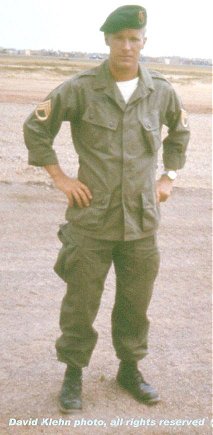
It is interesting to note that
the 1st pattern jacket is worn with out US ARMY tape, Para qualification
badge and SF shoulder patch, note the white T shirt which will be soon dye
green as per Military regulation (11/1965).
Photograph taken at DaNang in 1965, courtesy of SSG D Klehn,
A-113 Sr Commo
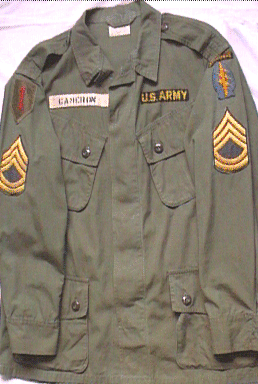
This
is the first pattern Jungle jacket and is from Sergeant First
Class R Cameron A-113/A-103 and is one that he wore early on in his tour.
The soldiers were issued two sets and the idea was to rotate them so that
both sets aged evenly, but most "old hands" put one aside
for inspections etc and wore the other one to hell. The one shown here is
one of his day to day jackets. "Yes, I had more than two sets as I
ran the supply shack." (Quartermaster Sgt). You will notice that
there is no CIB or Wings! "Some of the guys had pin-on metal
insignia", but he did not bother with these on his day to day
jackets, his inspection shirt is badge to hell with Second Award
CIB, Master Blaster (Master jump wings) and Vietnamese Jump wings and LLDB
pocket patch. "One thing you always tried to put up was your combat patch to
kind of let know you had been around the block so to speak. In the early
days, if you got a combat patch up you were more than likely a Korean Vet.
A lot of the old Nancoms were, at that time, thought some SF guys had
pulled some early TDs in Vietnam." Words or sentence in "italic " are as written by R
Cameron Courtesy of R Cameron and Kevin Lyles
(my collection)
Second
Pattern:
The
second pattern was
made of twill cotton poplin fabric, dyed Olive Green Army shade 107. The
jacket lost the inner gas flap at the front closure and the exposed
buttons were now concealed under a flap to prevent snagging but the jacket
retained the shoulder loops, side tabs .
The
trousers was identical to the first patterned but with concealed
buttons.
Third
and Final Pattern:
The
third pattern was
made of twill cotton poplin at first then rip-stop cotton poplin
fabric, dyed Olive Green Army shade 107. By that time the
shoulder loops and side tabs on
the jacket were gone as well.
The
trousers had lost its leg ties, the five buttons fly was replaced by a zip
with no inner flap and the single button adjustable tabs on the waist was
replaced by a slide tab.
The
third pattern was also produced in the Army ERDL camouflage pattern and the majority of 3rd pattern jungle uniform were produced in rip-stop material..
On
this photograph of members of A-103 taken in mid 1967, you can see the
second pattern jungle jacket been worn by one of the Sergeants kneeling
down on the right, the other sergeant behind him wear the first pattern
the rest of the team have the third pattern jacket except for two
sergeants wearing the Utility uniform.
Steve Sherman the
archivist for
the Special Forces and Special Operations Associations
Need your help!



.jpg)