|
As you can tell from SFC R Cameron own account, Special
Forces A-camps had some internal problems
with the LLDB and/or the CIDG. This did vary
a lot from one camp to another as well as
from one year to another! A-103 at Gia Vuc
had a very serious situation in Mai
1966.
"The way
I heard it was that the SF and LLDB got into
a firefight over the death of a SF team
member, rumored to have had a contract put
out on him by the LLDB demolition Sergeant.
The sergeant was still there when I
was there and was pointed out to me by other
team members."
"A year or so before my Tour, the SF
and LLDB teams at Gia Vuc got into a fire
-fight, resulting in casualties and a
complete change over of teams. When I
was there, both areas were separated from
one another by wire, trenches bunkers and
firing ports aimed at one another as well as
towards the outer perimeter!
They were many stories, and I was unable to
ever separate fact from fiction--though I
spent little time dwelling on it."
Cpt
Virgil R. Carter (Xo A-103 January 1967-July
1967)
For the straight and skinny about what happen on that day visit the "66 Shootout" page
A-103, May 1966 to September 1966,
by Cpt Steve Perry
After the shooting incident
between the CIDG and the A-team in late Mai 1966, it was decided to defuse the
situation by rotating the existing A-team with
a new one from Minh Long camp. "We
were staying in Quang Ngai B-Det while doing the area
recon for the new Minh Long camp when we received the
orders from C Det CO Ken Facey to brake A-110 team with half going to Gia Vuc under my command including team MSG
J.W. Slover and Sgt Paul Lowe (Radio operator) and for
the the other half to stay as the Minh Long team
under A-110 XO, 1st LT Bill Bueman with
Newsome (Commo), SSG Paul Whitehead (medic) and Mike
Stearns (weapons)."
Info thanks to A-110, CO Cpt Steve Perry

Back row, left to right
Cpt S. Perry, Team Leader, MSG John Slover, Team Sgt,
SSG Jim Moddy, Hvy Weapons Sgt,SSG Mike Stearns, Demo Sgt (KIA at Minh Long Mar 67),
SSG Paul Whitehead, Team medic, SSG Oddie Tucker , Lt weapons, SFC Fred Funk, Sr Medic , Lt weapons, SFC Fred Funk, Sr Medic
Front row left to right
1st Lt Bill Buhman, XO, SSG Paul Lowe, Sr Commo, SSG Ron
Mc Connel, Intel Sgt, SGT (FNU) Newsome, Jr commo, SSG Sam Hernandez, Lt
weapons
Cpt Stephen Perry A- team was formed at Ft Bragg in
July 1965 to deploy to Vietnam as an A- team in March 1966. The photo was taken at Fort Bragg
around the 14 March 1966 prior to departing with two
other A-teams to Vietnam. The trip was made over several
days on an USAF C-130 plane and ended to 5th USSF HQ at
Nha Trang, RVN. Cpt Perrys's team was destined to A-110
Minh Long new A-Camp, but after A-103 shooting in Gia
Vuc, half of his team was assigned to Gia Vuc: Slover,
Moody, Tucker, Funk, Mc Connell, Hernandez and Perry
went to A-103 Gia Vuc.
|
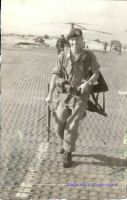
Cpt S. Perry
at Da Nang,
C-1
|
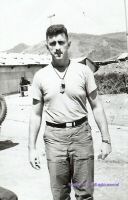
SFC Ron McConnel,
Intel Sgt A-103
Gia Vuc 1966-67
|
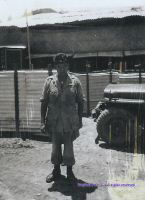
A true SF hero in my opinion. Then SSG Sam Hernandez, my first Demo Sgt as
a A-Det CDR.
|
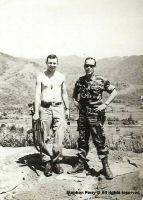
Cpt Perry
(left)
and CIA agent
doing some work with
Hre and Cua tribes.
Photo taken on the
east outpost
at Gia Vuc
|
|
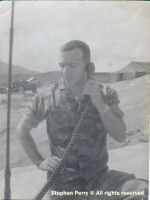
Cpt S. Perry
assistant S-3 C-1, joint SF, Marines and Korean
operation east of Da Nang. Circa Oct 1966
|

Cpt Steve Perry. I was on 5th SF Gp staff, Combat Readiness Team, in 1968 and made a trip with LTC Facey to Gia Vuc and met up with
1966
interpreter. When I had a bird dog crash north of Gia Vuc in July 1966,
he put together an indigenous rescue team that was going to go over land to try and find me.
|
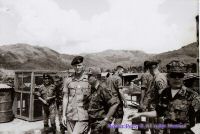
LTC Facey and VNSF from 5th Gp HQ. This was taken
at I CTZ camp (unknown)
n 1968 during my second tour. LTC Facey
was then
5th GP DCO
|
All information and photos on A-103 May 66 to
September 66 thanks to Cpt Stephen Perry

from L to R
SSG S.D. Hernandez, Cpt C.U. Thompson (KIA) and Sp5 W.G. Howe (soon
to be promoted to E5)
Photo taken in front of the Team house blast wall (Circa
Sep/Oct 1966)
Gia Vuc
Camp Forces
Circa 1966
 In
touch In
touch  To
be contacted Deceased To
be contacted Deceased
Please
see A-103 roster page for
full list of names
|
|
CO -
S. M. Perry
|
May
66 to September 66
|
|
|
CO - Cpt C. U. Thompson (kia)
|
June 66 to 11th Nov 66
|
|
|
CO - Cpt Dallas L Cox
|
January 67 to May 67
|
|
|
XO
- 1st Lt William H Chickering III
|
Sep
66 to Feb 67
|
|
|
Team
Sgt - MSG J. W. Slover
|
May
66 to January 67?
|
|
|
Team Sgt
MSG Billy Greenwood
|
January
67 to ??
|
|
|
Intell
Sgt, SSG Ron Mc Connel
|
?-66
- ?-67 |
|
|
Hvy
Wpns, SSG Jim Moddy
SFC Ralf A. Loff
|
October 66 to ??
|
|
|
Lt
Wpns, SSG
Oddie Tucker
(passed
away 1988)
SSG Samuel D.
Hernandez
|
March 66 to March 67
|
|
|
Sr
Demo SSG Franklin T. Dailey
|
January
66 to
January 67 ?
|
|
|
Jr
Demo ?
|
? |
|
|
Commo
SGT Paul A. Lowe
|
March
66 to March 67
|
|
|
Commo
Sgt Gary Bowes
|
October 66 to January
67
|
|
|
Commo Sgt William G.
Howe
|
September 66 to May
1967
|
|
|
Medic SFC
Wolfram W. Bischof,
(kia Thoung
Duc 02/13/67)
Small write up on
SFC Bischof in the February 1967 edition of
Green Beret, page 5, reprints available from
http://www.specialforcesbooks.com
|
?/? 66
to ?/? 67
|
|
|
Sr
Medic SFC Fred Funk, Sr Medic
SFC Albert Lansberry
|
October 66 to November 66
|
|
|
Jr
Medic SGT Benjamin L. Long
|
June
66 to April 67
|
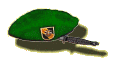
A-103,
January 1967 to
May 1967,
by Cpt Dallas
Cox
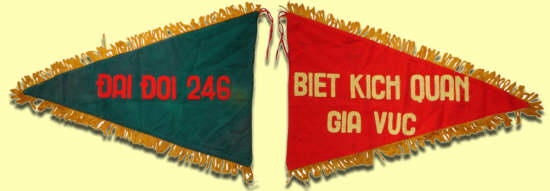
Guidon from CIDG company 246, Gia Vuc, which was
given to Cpt Dallas Cox when he rotated out of Gia Vuc
in 1967
One of the problems that we had at Gia Vuc was
getting the Vietnamese SF to patrol in an aggressive
manner.
We had one old Vietnamese Warrant Officer who was a
real soldier and had fought with the French.
We were probed on several occasion when I was there. It appeared that the opposite largest forces were about
company size.
We were successful in many of our ambushes and kept
most of the forces that were using the Ho Chi Minh
trail
away from Gia Vuc.
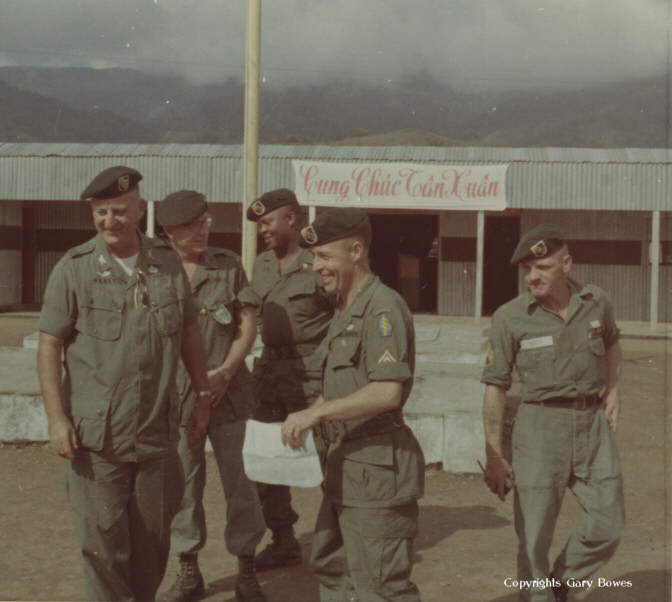
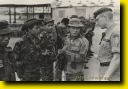
TWO PHOTOS BELOW WERE TAKEN DURING COL KELLY
VISIT TO GIA VUC IN FEBRUARY 1967

From left to right
Col Kelly, Cpt D Cox (A-103 CO), SFC L Wardlaw, SFC M
Meade and SSG F Dailey, courtesy of Gary Bowe
this second photo was taken a few minutes
later
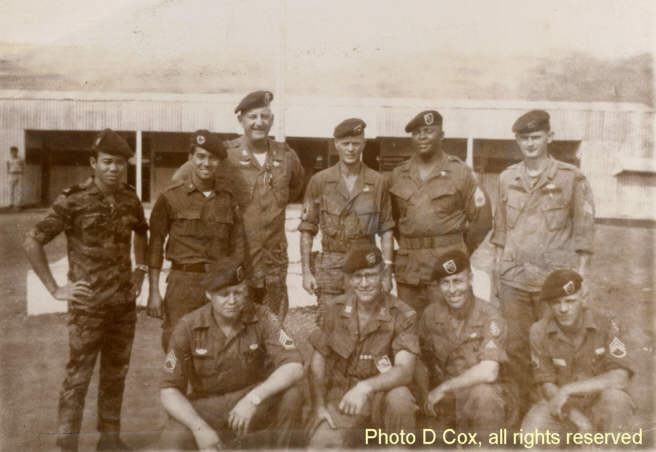
From left to right and Top to Bottom
Vietnamese CO and XO ?? , Col Kelly, MSG
Billy Greenwood, SFC L Wardlaw, SGT Ben Long
SFC ???, Cpt D Cox, SFC M Meade, SSG F
Dailey
Letter of appreciation to MSG Billy Greenwood
written in Gia Vuc on the 7th of March 1967 by Cpt
Dallas Cox, A-103 CO
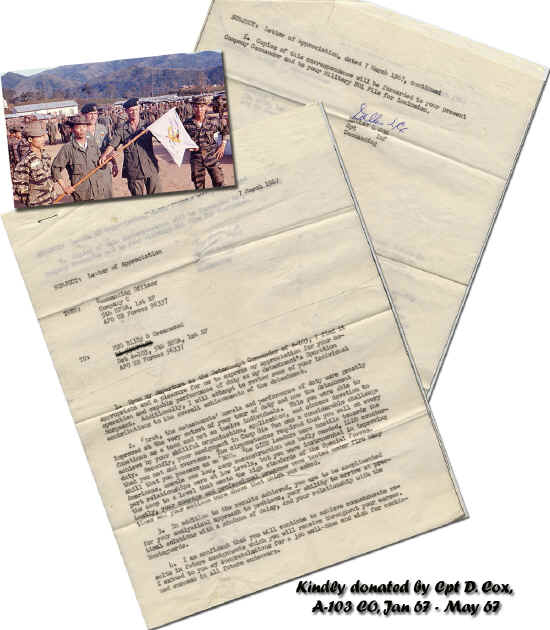
Please click to enlarge
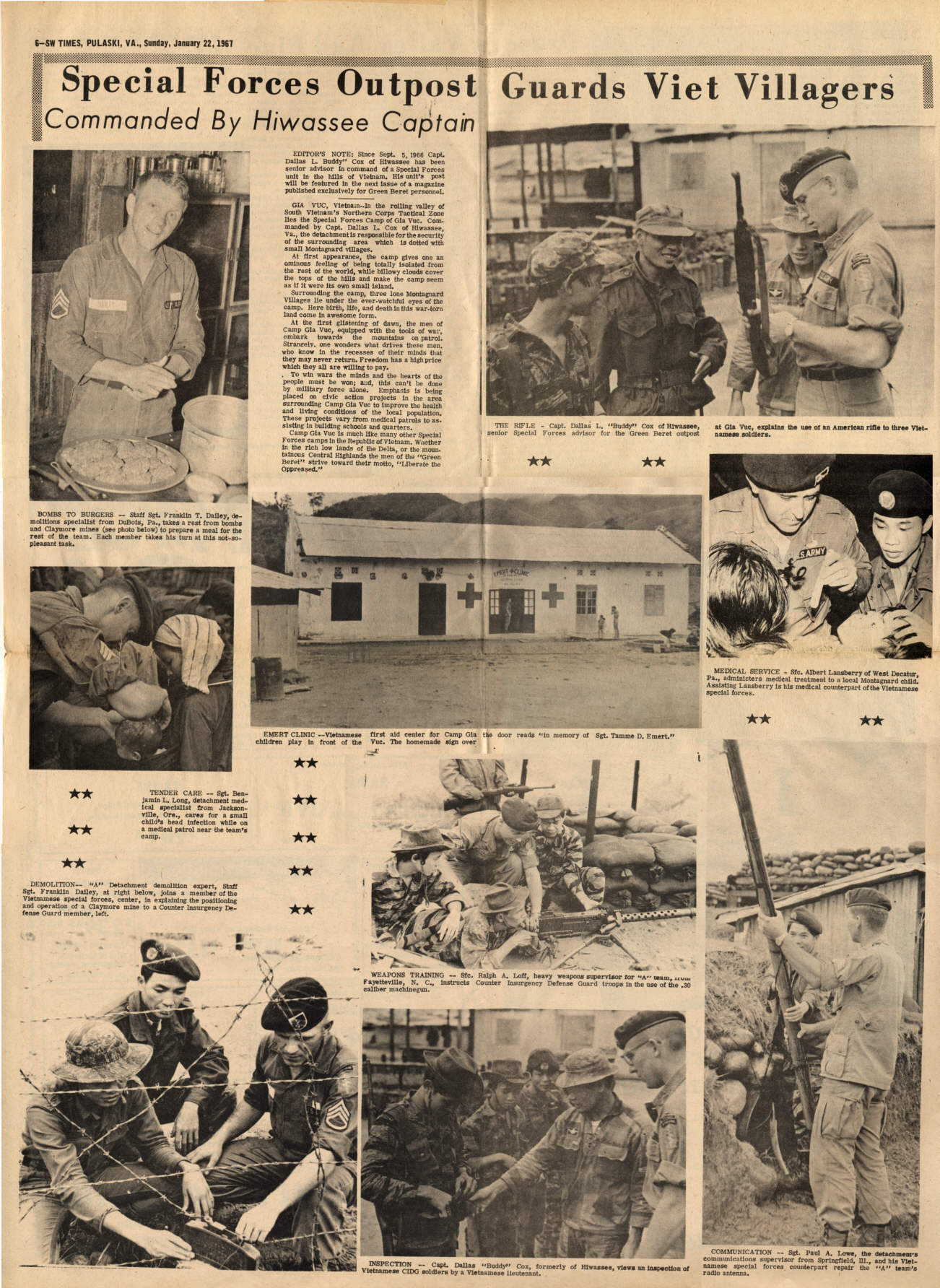
Gia Vuc news paper article from the Pulaski
SW TIME, Sunday January 22 1967 (Courtesy of Cpt D.L Cox)
|
|
|
|
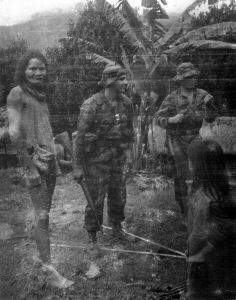
Two photos taken during one of
Gia Vuc MedCap,
From left to right: Village chief, Sgt Bill Howe
and Cpt Dallas Cox,
Please click on photo to
enlarge
|
The
1966 December issue of the Green Beret Magazine
has an article on
Gia Vuc on page 5:4 and 5:5. Photos below
are from that article and are courtesy
of Steve Sherman, Radix Press. All rights
reserved.
_tm.jpg)
SSG F.T.Dailey with the help of a LLDB NCO
demonstrate the use of claymore mine to a CIDG
soldier
|
_tm.jpg)
Sgt B Long treat a child head infection
while on a routine MEDCAP.
_tm.jpg)
Sgt P.A. Lowe erect an aerial mast
|
_tm.jpg)
SFC A Lansberry examine a montagnard
child's throat with the help of his LLDB
counterpart.
_tm.jpg)
"Cook for a day" SSG F.T. Dailey |
|
_tm.jpg)
SFC R.A. Loff instruct the use of the 30cal
machine gun to a "yard"
Reprints of the Green Beret
are obtainable from Steve Sherman Radix Press 
|
A-103, January 1967 to July
1967, by Cpt Virgil Carter
CAMP FORCES
The camp had a Special Forces A-Team of about 8 to 9 (2
Officers and roughly 6-7 NCOs) and LLDB A-Team of about
equal numbers.
The strike force consisted of 3 companies of Montagnards
from the Rhe Tribe and a Recon/Scout Platoon, roughly
400-450 in total. They were typically organised with one
company for camp defense, one for the three hilltop
outposts and critical high ground on the North West,
North East and East and one company out on continuous
operations. The companies were rotated monthly.
Dependants lived in the camp with the strike force
A-Team as follow:
In
touch To
be contacted Deceased
A-103
Team Members in 1967 (due
to rotations please see A-103 roster)
.jpg)
March/April 67
Top from left to right
Cpt R. O Schreer (CO), SFC C.W Lindewald (Sr Lt Wpns) (MIA/KIA
Lang Vei Feb 68)
, Sgt G Young (Medic), SFC R Knight
(Demo), SFC James H Hoskins (Sr Hvy Wpns), Cpt V. Carter
(XO),
Kneeling:
SFC James McGlon (Team sgt)
and SP-4 Chuck Woodson (Jr
Commo)
Identifications of A-103 Team Members
thanks to SFC J. McGlon
.jpg)
A-103 January 67
Top from left to right
Sgt Long (Jr Medic), Sgt Brown (Sr RTO), SFC Wardlaw (hvy
wpns) SSG Dailey (Demo), Cpt Carter (XO), Cpt Cox (CO),
MSG Stover (outgoing Team Sgt)
Kneeling
SP4 Bowes (Jr RTO), SSG R Flemming (Sr Medic), SFC Meade
(Intel), MSG Greenwood (incoming Team Sgt)
Identifications of A-103 Team Members
thanks to Cpt Carter
.jpg)
One of the 3 CIDG company showing the company
Guidon, held by the CIDG company commander and MSG Billy
Greenwood, ( team senior NCO and company advisor), on
the right is the LLDB XO. This was taken during a
big ceremony for outfitting all the companies with new
uniforms, this was done for troop moral. On the back
ground you can see a deuce and half truck and the supply
building .
.jpg)
Rice wine drinking, part of the yards way of
life.
From right to left is Cpt Carter XO , SP4 Chuck
Woodson, standing Cpt R. O Schreer CO, Neigh our interpreter
and the E6 is Joseph P. Smith (C-1 Awards and
Decorations Clerk attached to A-103 for 3 months)
|
All photos below are from A-103 Ttaken by
Cpt Virgil Carter, from Jan 67 to Jul 67
_tm.jpg)
C-123 taking off at Gia Vuc air
strip, in the back ground, you can see
Thunder Mountain. |
_tm.jpg)
Caribou landing at Gia Vuc
airstrip, in the back ground you can see one
of the villages. Your are looking North
towards the Song Be valley, main VC/NVA
infiltration route.
|
_tm.jpg)
Taken during companies new
uniform outfitting ceremony.
|
_tm.jpg)
Taken during companies new
uniform outfitting ceremony.
|
_tm.jpg)
Cpt V Carter in the team
house.
|
_tm.jpg)
From left to right,
Cpt Scheer,
MF Australian from Danang, , SFC J Hoskins,
SFC McGlon and another Australian from the
Mike Force
|
_tm.jpg)
Mike Meade at work
|
_tm.jpg)
Cpt R. O Schreer and medic
B Long
|
_tm.jpg)
Barbecue outside the team house,
L-R: SP-4
Chuck Woodson & SFC James McGlon .
|
_tm.jpg)
Photo taken with back to
main entrance, the US team house is the
building in the background on the right end
side.
|
_tm.jpg)
Gia Vuc north east wall
|
_tm.jpg)
Gia Vuc medal of Honor position,
this was at the top of the observation
tower, commanding good views but very
exposed to enemy fire!
|
_tm.jpg)
Photo taken looking
eastward toward Bato
|
_tm.jpg)
Pictures are from the infamous Marine
Corps 4.2"mortar!
|
Unfortunately
for us, the thing had the same range as our
4.2"mortars in the camp, so the episode
didn't help improve our long-range firepower.
I'm betting it did improve our reputation with
the Marines around the DaNang airport.
|
Story
and photo thanks to Cpt V.R. Carter A-103 XO,
January to July 1967
|
|
A-103,
1
November 1967 to 5th May
1968
Thanks
to SGT
Robert
B.
MacPhee
Camp
Forces
Full A-Team as follow:
In
touch To
be contacted Deceased
|
|
CO-Cpt
E O'Keefe |
|
|
XO-1st Lt
J Coughlin |
|
|
|
|
|
Team Sgt
MSgt J Shepard
"Wild
Bill" |
|
|
Intell
SP5 P Nay
(11/23/13)
|
|
|
Wpns SFC
Heflin |
|
|
Wpns
SSgt Milton |
|
|
Demo Sp
5 S Feldhake |
|
|
Demo Sgt
SFC
Jones / SP5 P Nay |
|
|
Commo
SSgt C Rucker |
|
|
Commo |
|
|
Medic |
|
|
Medic
SGT Robert
B. MacPhee |
I
was in Gia Vuc from mid
October 1967 thru most of
April 1968. I had spent
about 10 days at the C
Team, Danang before being
sent to Gia Vuc. my time
at the C Team entailed
working at the dispensary
with Dr. Hunter, MD and
one Mike Force operation
in
Quang Tri Province, NW of
Danang. In mid October I
was sent to Gia Vuc to
replace SSgt George Young,
team medic, who had
suffered rat bite injuries
to his feet.
My
first impression of Gia
Vuc was how remote and
beautiful it was. While I
didn't know much about the
montagnards before
arriving in Gia Vuc I had
been told, at the C Team,
that the Hre tribe was primitive
even in
comparison to the other
montagnard tribes. It
didn't take long for me to
learn how primitive the
Hres were. Not a single
Hre was literate. the
tribe language was monosyllabic
with no formal symbols
used for any purpose. A
few Hres adopted hybrid Vietnamese/French
words such as beaucoup.
Otherwise numerical
references didn't extend beyond
what could be expressed
using fingers and toes.
Beaucoup was, pretty any
number more than could be
expressed directly.
The
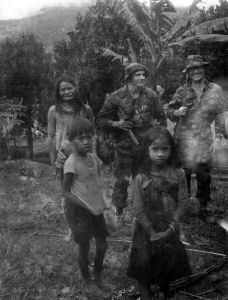
black and white photos
were taken by
interpreters. One in
particular, nicknamed Jim. He was the most
trusted interpreter
working with the A 103
team. He took most of
the black and whites.
The color photos were
taken with a Yaschica 35
mm, 45 mm focal length
camera.
Slides, on
the other hand, were
taken later using my
rare Canon Pellix 35
mm.
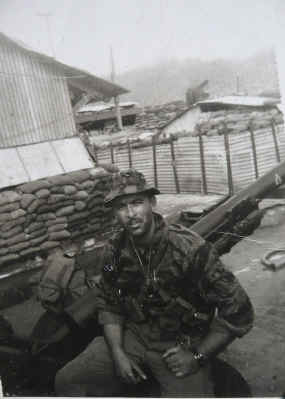
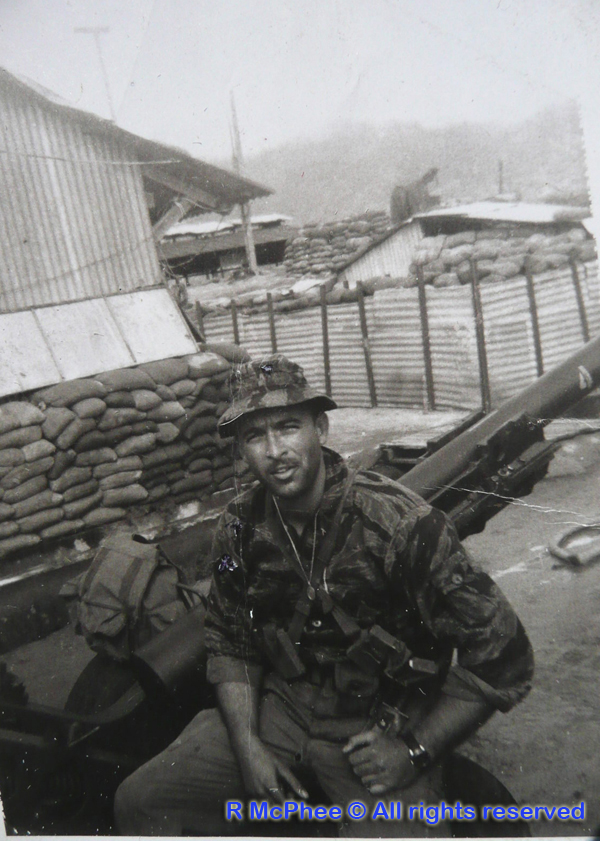
SGT
Robert B. MacPhee after a four
day recon.
Photo taken a the camp
"105 mm
howitzer"
which in
fact is the early 1967
"Da Nang stolen"
wheeled 107 mm
(4.2 inch)
mortar,
see the the stories below.
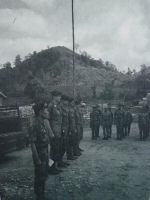
Very
early
1968.
I
can't
recall
the
name
of the
LLDB
Lt. in
the
foreground
but I
do
remember
that
he was
a good
soldier.
The
Americans
are,
from
nearest
the
camera:
Capt.
O'Keefe,
CO,
Lt.
Coughlin,
XO,
SFC
Jones,
demo,
SSgt.
Rucker,
commo,
and
Sgt
MacPhee,
medic.
|
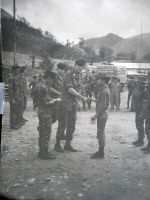
Capt. Edward O'Keefe is
giving one of the Hre troops
an award. |
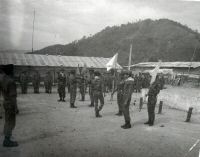
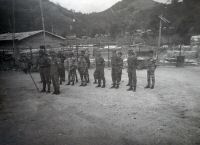
"parade
ground"
depict
A
Monday
morning
inspection
of our
troops,
the
issuing
of
pay,
awards
and
anti
malarial
medicine.
|
 |
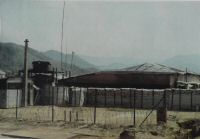
Team
house
with latrine
and
shower
room
on the
left
hand
side
|
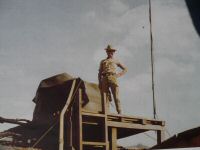
Standing
next
to
the
water bladder
on the
roof
of the
shower
room
is
Dinh
Mit.
He was
a
former
scout
for
the French
military
during
the
1st
Indochina
war. |
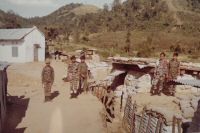
The
path
going
up
the
hill
is
to
one
of
the
two
outposts,
N-E
and
E of
the
camp.
Since
the
50
cal
MG
was
on
my
roof
and
the
81mm
mortar
was
in a
pit
just
outside
of
my
door,
I
was,
usually
involved
in
supporting
the
outposts.
The
bunkers
were
a
combination
of
materials,
to
include:
trenches,
sandbags
stacked
and
retained
by
corrugated
metal
sheets,
concrete/stone,
and
overhead
log
beams
with
sandbags
and
or
dirt
on
top.
Especially
along
the
eastern
bunker
line
there
were
small
sleeping
accommodations.
|
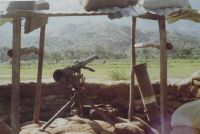
57mm
recoilless
rifle
aimed,
pretty
much
WNW,
perhaps
280-290
deg...
To
be
used
only
by
the
SF
personnel.
If
you
look
closely
you
you
will
see
the
grass
landing
strip
running
across
the
middle
of
the
picture.
This
would
have
been
the
last
couple
of
hundred
feet
at
the
N
end.
Just
above
the
hooches
you
can
see
a
tree
line
along
the
Song
Re.
Beyond
the
foothills
is
the
base
of
the
Annemites.
|
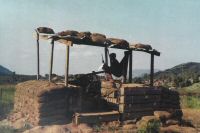
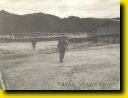
a
Montagnard
on
guard
watch
duty
over
looking
the
runway
which
bordered
the
camps
outer
western
perimeter.
|
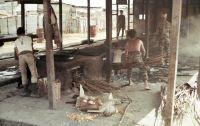
The
Yards
in
the
pictures
are
preparing
a
mid
day
meal
for
the
ones
on
duty.
Rice
was
an
everymeal
component,
edible
gourds,
melons
and
meats
complimented.
Meats
could
be
chicken,
pigs,
fish,
small
game
occasionally
|
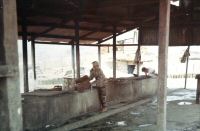
You
can
just
see in
the
back
ground
the
57mm recoilless
on top
of the
North
West
corner
bunker,
the
most
likely
NVA Armor
attack
route.
|
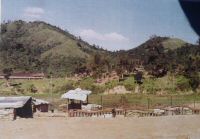
Eastern
perimeter
wall
looking
towards
the
two
Eastern
outposts
|

The
village
in
the
background
is
Ap B
(Ahp
Bay).
Ap A
(Ahp
Ahh)
is
just
out
of
the
picture
to
the
left.
The
two
were
separated
by
only
the
dirt
road
to
Ba
To.
Ap A
was
on
the
N
side
and
Ap B
on
the
S.
|

Distant
background
shows
the
original
and
more
affluent
village
at
the
base
of
the
hills.
In
the
closer
background
the
pen
like
structure
is
exactly
that,
a
livestock
pen.
The
yard
troops
kept
animals
in
it
for
eating
later.
Running
across
the
middle
of
the
pic
is
the
dirt
road
leading
to
Ap A
and
Ap
B.
Beyond
those
villages
the
road
leads,
eventually
to
Ba
To.
|
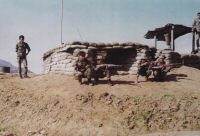
Taken
on the
eastside
of the
camp
just
south of
center
towards
the main
gate.
There
were
underground
bunkers
beneath
the guys
posing
on the
berm. I
would
estimate
this was
at about
110 deg
from
true
north.
|
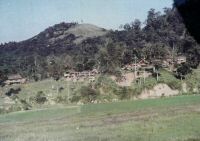
Village
North
East
of the
camp, also
see in
one of
the
photo
above
(J-L)
|

VC
prisoner
being
escorted
by an
MP to
a Huey
from
the
174th
AHC
based
at Duc
Pho in
Quang
Ngai
Province
(J-L)
|
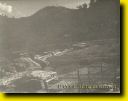
Some
of
the
album
pics
show
the
hills
east
and
northeast
of
the
camp
on
which
outposts
were
situated.
Hills
to
the
south
east
and
south
were
quite
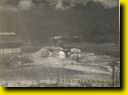
a
bit
more
distant
and
didn't
contain
outposts.
Foothills
west
of
the
Song
Re
had
no
outposts.
The
Anamite
Mountains,
named
by
the
French,
ran
for
several
hundred
miles
along
the
northern
Cambodian,
Laotian
and
North
Vietnamese
borders.
In
our
AO
the
highest
points
were
well
over
2000
meters.
|

MSgt.
Shepard,
team
sergeant,
and, I
believe,
Sp. 4
Concannon
followed
by
their
Hres
returning
to
camp
after
an
overnight
ambush
|
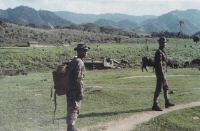
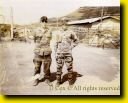
Couple
of
camp
Montagnards
on the
way to
a
party.
Rice
wine
is in
the
ceramic
jug
inside
in
rucksack.
|
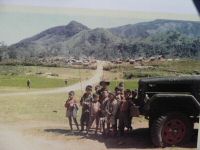
Kids,
all
boys,
are
posed
near a
damaged
2 1/2
ton
truck
about
50
yards
south
of the
camp
entrance.
Boys
play
and
party,
girls
work
|
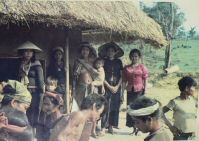
Pre
Tet
Offensive
several
SF
cmps
in I
Corp
where
attacked
by
the
NVA.
Lang
Vei
and
Kham
Duc
camps
were
overrun.
Other
camps
were
reinforced
by
Navy
SeaBees.
In
addition
to
the
reinforcement
of
Gia
Vuc
a
small
school
house
was
built.
.
|

The
chief,
Dinh
Roi's,
daughter,
wearing
the
violet
colored
blouse,
assisted
me. At
the time
she had
not had
her
front,
upper
teeth
ritually
removed.
"Gigi
interpreted
for
us"
|
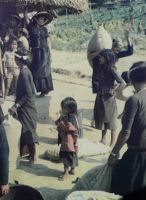
The
following
photos
depicting
rice and
ratan being
issued to
recent
refugees
were taken
at this
modest
building
|
_tm.jpg)
|
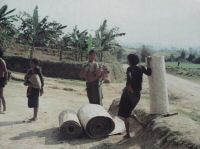 |

This
photo
was
taken
from the
school
building.
The dirt
road was
used by
SF
troops
to drive
to a
small
beach
where
there
was sand
used for
sand
bags. |
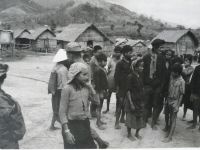
Recent
refugees
who had
arrived
from the
mountain
sides.
By the
time
they the
photos
were
taken,
the
newcomers
had been
deloused,
cleaned
up and
given
new
clothing.
|

Refugees
waiting
for
provisions
to
include
food
and rattan
sections
with
which
they
begin
building
shelter.
|
***
A
couple
of
shots
were
found
showing
the
longest
established
and
most
affluent
village,
Ap A.
This
means
village
A. A
being
pronounced
ahh.
They
were
shot
from
inside
the camp
in the
northeast
sector.
There
was a
minefield
between
the
camp's
out
barbed
wire and
the rice
paddy. I
hope
someday
to find
the
photos I
took
showing
the
skilled
craftsmanship
that the
Hres
used to
build
these
structures.
***
|
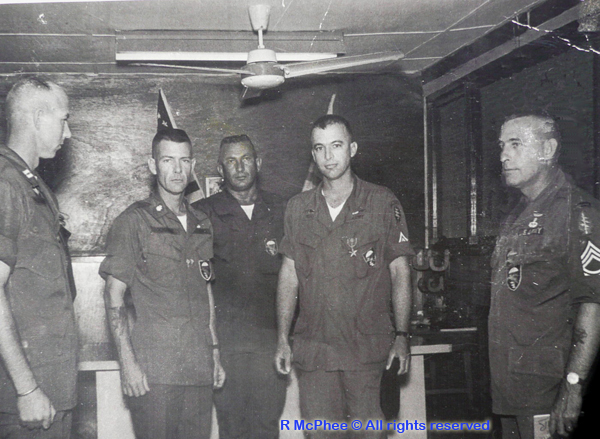
Photo
taken mid to late
March 1968, by a
photographer
at the C Team, Danang
at the BSM presentation
I
think Capt. O'Keefe received
his BSMV, for the O'Chai
encounter just after I
did.
I can't remember the names
of the guys in the room
except for Lt Col. Daniel F.
Schungel
who is to my
right.
He was the CO of the C Team
during the entire time I was
in I Corps and was at Lang
Vei SF camp when it was
overrun by the NVA.
"Can
anyone else put names to the
others"
Above Information and photos thanks to Sgt
Robert B. MacPhee (A-103 Medic)
A-103, 31st of January
1969
Gia Vuc A-camp turnover to the LLDB
The USSF after leading successfully for 7 years Gia
Vuc CIDG camp,
finely turned it over to there Vietnamese Special Forces
counterparts.
A big official ceremony was held where Cpt E Sittler's
A-team CO bid farewell to the LLDB team led by Day Uy Chu
and their CIDG soldiers. Members of
the A-103 team were reassigned except for Sr Medic Bill Aschenbach who stayed behind to
smooth the transition and help the LLDB commander with
liaison work with the USSF C team in Da Nang.
Gia Vuc's immense success is clearly demonstrated by the
increase of Hre Montagnards living in the area.
The first A-team in 1962 found 1500 Hre living in that
area but when Cpt E Sittler's A-team departed seven
years later, 6500 Hre were living under the protection
of the Gia Vuc A-camp with more people arriving daily.
***
Thanks to SGT. WILLIAM G.
ASCHENBACH, Team senior medic, we have an account of this historical
moment.
A-103 team at the time of the turn over was very short with having only one NCO
per positions apart from the Medical one. This caused physical strain on the
two Medics as they went on every other operations. Sgt John
McCullough,
Bill's fellow medic suggested the
idea to try one American per
patrol as they were just flat
worn out by flip flopping
operations. John asked him what
he thought and offered to try it
first as it was his idea.
During his first
operation on his own, he was threaten by his CIDGs of being killed if they were
shot at during the operation and the idea of sending just one US per patrol with
no US backup was abandon by the Team.
(Interesting to note that after 7 years of training, the same low
combativeness encountered at the beginning was still apparent in some CIDG
units! In reply to one of my question Bill said: CIDG and LLDB did tolerated
each other, especially Vietnamese CIDG. The Montagnard company #134 not so much.
134 was my favorite and best company to work with.)
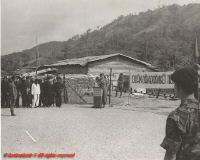
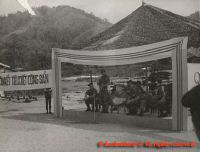
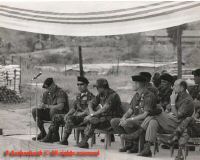
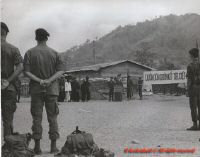
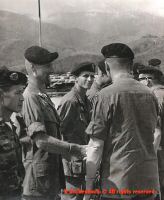
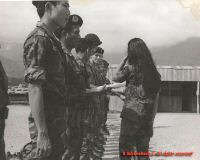
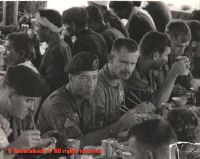
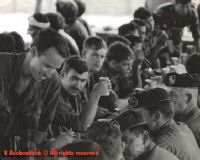
The turnover day celebration started with a
CIDG parachute jump over
camp. The camp was filled by brass from the C Team and U.S Army, French and
German press corps. (The photos I sent you were gifted to me by a French woman
photo journalist.)
There was a meal
shared by guests and team A 103 ,CIDG and LLDB.
A few officers spoke briefly at
conclusion, the Team then formed up and
was congratulated by all. Following this they walked to waiting choppers and
loaded up except for myself. The
Team except for Capt Sittler were sent to A 334 Tong Le Chon to replace that existing
team.
Dai
Uy CHU,
the LLDB commander was outstanding and exceptional Vietnamese
officer. My counterpart SSGT. Dinh Van
Minh and I functioned well together. He was a good soldier, Bacsi and a good
friend.
Both credit to the LLDB.
My only problem with the LLDB during the aftermath
of turnover occurred the very next morning.
I went to get coffee from our team
pot and got hot water,
THEY WERE MAKING TEA FROM OUR COFFEE POT ! I WAS PISSED!
After their departure I moved my bunk into the commo bunker as I had to
make frequent radio checks with C team during nights. I stayed alone
with the LLDB thru February when Tien Phouc went under siege. In March when
their Medic got killed, I
was inserted to replace him, Capt. Paul Turner
the surgeon at C team accompanied me to, as he stated he wanted to experience
what his Bacsis had gone thru.
He was a honorable and capable surgeon and human
being.
When I left
Gia Vuc there were no other Americans in camp.
Information
thanks to Sgt W. G. Aschenbach (A-103 Sr Medic)
Additional
information thanks to Bob Gilmartin and Steve Sherman
The transfer to LLDB in 1969 did not take the camp out of the SF
supply chain and Gia Vuc was very much part of C company and
active. Gia Vuc would only have lost its connection to USSF in
September 1970 when it was turn over to the 70th RVN Rangers and
became part of Vietnam Army Ranger Command.
Gia Vuc camp was not overrun until September 1974,
which is quite remarkable due to its remote location.
For more information regarding the camp after 1969, visit
"After 69web page"
Would like to get in touch
with anyone having served in Gia Vuc during 1969 to 1974
|
Camp
Forces
Reduced A-Team as follow:
In
touch To
be contacted Deceased
|
|
CO-Cpt E Sittler |
|
|
XO-1st Lt T Guider |
|
|
CAPO 1st LT.
D Dunkum |
|
|
Team Sgt
SFC C McNulty |
|
|
Intell Sgt
SFC E Salaz |
|
|
Wpns Sgt
SFC C McNulty
|
|
|
Jr Demo
Sp5 W Souser |
|
|
Commo
Sgt R
Rodriguez |
|
|
Sr Medic-Bill
Aschenbach |
|
|
Jr Medic
Sgt John
McCullough |
 |
 |
 |
 |
 |
 |
 |
 |
 |
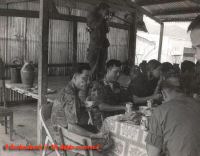 |
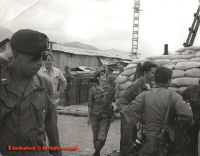
Photos
thanks to
SGT William. G.
Aschenbach |
|
If you have the chance, please read the two articles on
Cpt E Sittler A-team in the Green Beret Magazine
"FOUR
NEWS SCHOOLS FOR GIA VUC" The
Green Beret January 1969, page 10
"SHANGRILA Special Forces Advisors Leave"
The
Green Beret April 1969, page 16
The
Green Beret magazine reprints
are available from Radix
press
|

|
|
|
A-103 105mm
Howitzer! Isn't it?
I
had been in Da Nang for several
Intel Briefings and spotted what appeared
like an 105 Howitzer which had been in
the same location for a couple of months.
So
on one of the last trips to the C Team, I
told Sgt P Brown (who had just
finished scrounging for food) to go to the
air strip and get me that 105 (I thought
that was what it was because of the wheels
and frame).
Brown said to me, How do I get it???
I said back up to it just as it was yours
and take it to the Caribou ramp, where I
will meet you with some 105 ammo.
Brown did as I said, but some pallets were
blocking-in the weapon! An Air Force MSG
appeared and asked him if he wanted any
help, then got a fork lift truck and moved
all the pallets for him and helped him to
hook the weapon to the truck. We both
got to the Caribou at the same time,
loaded everything and off they went to
the camp.
When
the plane arrived in Gia Vuc, Team Sergeant
Billy Greenwood and the rest of the team
were waiting to unload it. Once the weapon was
rolled off Greenwood asked What the hell is
was?
After
studying it for a while, Weapon Sgt James
Hoskins determined that this was in fact a
4.2 mortar despite the 107 How ID plaque.
As it was on wheels we were able to fire
charge 65 without having to worry about the
recoil danger Zone and we certainly
surprised the VC when we started using it!
"Story
thanks to SFC James McGlon (Intel & Team
sgt), 1967"
A-103
4.2 Mortar
On one patrol (probably with Lt Carter 'cuz
we always ended up on patrol together!) we
were doing our 'recon' thing. Things
had been pretty quiet when we came under
small arms fire. Things were getting
intense and we
couldn't withdraw from the firefight -- so
we radioed for help. We provided base
camp our coordinates (as best we could
determine) but Sgt Wardlaw said that we were
out of range of the camp's 'four deuce'.
Since we had plenty
of incentive, we were rather insistent that
we could use some help!
We were told by base camp to maintain
position; they were working on something.
After about fifteen or twenty minutes Sgt
Wardlaw radioed that he was in position and
about to fire the 4.2 -- we were to provide
fire
control info. We heard a faint dull
"thump!" and heard the explosion
-- from behind us. We radioed that
this was NOT going to do; the round was
short. Wardlaw replied that he was at
max charge -- 45 sheets. Another
pause followed. The radio crackled to
life. It was Wardlaw asking us to let
him know how THIS round is. [Slightly
louder "thump!" followed by that
intermittent sucking sound] The round
landed a hundred yards ahead of us.
Yeah!! "Fire for effect!!"
was our next transmission.
By this time the VC knew they were within
mortar range -- so they took off. We
radioed that the VC had broken off the
firefight and that we were continuing with
the mission. We never did get the next
three rounds. When
we got back to base camp, we asked why Sgt
Wardlaw had not fired the additional rounds.
It was then that he told us what he had
done.
Wardlow had put a four-deuce in the back of
the camp truck and driven northwest to where
the bridge was out. Since the first
round at max charge of 45 sheets was short,
Wardlaw had to "improvise".
He put 54 sheets on the
test round and poured a soup-can-size can of
gasoline down the mortar tube. When he
dropped the round and it fired, it cracked
the 239 pound base plate of the 4.2 mortar!
He
COULDN'T fire any more rounds! Thank
God that once was enough!!
Story thanks to Gary
Bowes, Sgt E5, Radio Operator A-103, 1966/67
A-103
WP
There's
another great story about a WP round on
this same day, whose charges did not
explode, and the round left the muzzle,
rose about 50'-75', with the unexploded
charges burning like crazy,
and thereafter fell back to earth, with
the entire team setting new land speed
records getting out
of the area before impact.
Fortunately, we lived to tell the tale,
mainly because the round had not rotated
sufficiently to arm and explode on impact.
Whew!
Story
thanks to Cpt V.R. Carter A-103 XO,
January to July 1967
A-103
Funny story on one Op:
We
were always looking for ways to lighten our
load and reduce the size of what we carried.
A buddy and I found a Da Nang street vendor
selling nylon string netting hammocks that
could be rolled up into a ball which would
fit in your fist. It weighed nothing! We
went wild and bought some.
Next Op, we both took them out and strung
them the first night after dark.
Each of us crawled into our hammock. Next
thing was a loud twaaaaaaang!
Twaaaaaaang, twaaaaaaang! Followed by
sumbitch, momma hootcher and other sorts of
exclamations as my buddy and I each picked
ourselves up off the ground.
The hammocks would support a Vietnamese
(presumably) but not an American with boots
and rifle! The Yards really broke up
over that one. That was an operation
were we wound up sleeping on the ground the
whole time.
Story
thanks to Cpt V.R. Carter A-103 XO,
January to July 1967"
A-103
Interpreters:
We
had several interpreters. The one that I
always used was the senior in the camp. He
was a small, older Montagnard, with a bad
leg, that caused him to limp severely, but
he went out on all operations. Spoke
excellent English, and had a wonderful
attitude. His name was De Neigh,
pronounced Knee-uh! When I left the camp to
go back to the C Team to be the Engineering
Officer and design the Lang Vei camp, I gave
him my personal .45 pistol. I was worried
about his well-being, as the VN didn't like
him much and as long as the Americans were
around, he'd take little of their
intimidation efforts.
"Story
thanks to Cpt V.R. Carter A-103 XO,
January to July 1967"
The
interpreter, De Neigh, was a great little
man. We were on a lot of patrols
together, he hated the LLDB because they
broke his leg while he was going to
jump school. Despite his limp, De Neigh was
one of the only few who made it on top of
"Thunder Mountain", the huge
mountain across the river heading into II
CORPS.
"Story
thanks to SFC James McGlon (Intel & Team
sgt), 1967"
Fishing
the Montagnard
way:
This
was done by most
Montagnards,
tribes. They
build rock dams
across rivers
and streams.
Most of the time
water flows over
the damns and
through the
rocks. While the
upstream water,
behind the dam,
is a little
deeper these
dams really
don't impeded
the flow
noticeably.
Spaced evenly
across the dams
there are
spillways.
Conical stick
baskets, or
traps, are
positioned in
the spillways.
Built up water
flows forcefully
through the
spillways
carrying fish
with it. The
most of the time
the flow is
strong enough to
keep the fish
from swimming
back out. My
favorite fish
was, I believe,
some sort of
trout.
Basically, it
looked just like
trout I'm
familiar with
except it had an
elongated body
that made it,
almost, look
like an eel.
"Story
thanks to Sgt Rob McPhee, Medic, 1967-68"
High
jump over Gia Vuc, 15th May 1968
This
is not an A-103 story but relate to Gia Vuc
"We made a jump at
Gia Vuc, one at Tra Bong ans one at Ha Thanh.
This is one on those, "No shit. This
really happened." war stories.
It's hard for me to make a short story of
anything so please bear with me. I left
A-102, Tien Phuoc, sometime after Tet '68
and became the CA NCO for Co. "C."
I worked under a Cpt and 2 Lts. I had a
Vietnamese driver, an interpreter and five laborers.
It was really a cherry assignment. I worked
directly with the civilian agencies like
CARE which supplied rice etc. to I Corps
refugees. I'd pick up the supplies in DaNang
and move them to my warehouse at Co.
"C." From there I would distribute
the supplies to The I Corps "A"
Teams. Since I was pretty much on my own, I
usually accompanied the loads to the
"A" Teams. Occasionally I'd get an
AF Caribou but most of the time time I flew
with Air America. And usually with the same
crew. Didn't care much for the AF due to
their flight regs.
The kicker on the crew was Eugene Hasenfus
(later of fame during Reagan's War). He.s
the guy that survived the crash of the Air
America C-123 in Central America.
Anyway, Eugene, like me, was a skydiver. We
had lots of time to chat and somehow came up
with this idea to do a little jumping. We're
going way back down memory lane now (43
years) so some of the details are a little
fuzzy. He must have had his gear in Nam with
him, but I have no idea where I would have
come up with a 7TU. I have no memory of it
but I am sure we had a rigger shop in DaNang.
I got to pick which loads went where
and when. We'd fly out to the "A"
camp, zero our altimeters, stick a wet
finger up into the wind (I guess????) and
fly back to DaNang. I'd schedule the next
load for the same "A" Camp. On the
second run , the pilot would not level off
as normal but would continue to climb all
the way back. Somehow (????) we determined a
"spot" and jumped. I always
carried a .45 so I assume I was armed.
Somehow (????) we always landed on the
runway. Gia Vuc was the highest jump because
it was the farthest away (1 hour, if memory
serves.) Since these were
"clandestine" jumps we didn't
pre-announce our arrival. God only knows
what would have happened to me if Hodge had
found out what I was doing.
We were only met one time. As we were
getting our gear together for the return
trip, this jeep came screaming (as best a
jeep could) out of the gate and the driver
wanted to know just what the hell we thought
we were doing. He then informed us that the
entire area around the runway was mined (As
if that should have been our greatest
concern.) I think back now and ask myself,
"what the hell were you thinking?"
There was no way to be sure how much the
wind had shifted since our last visit and no
way to determine winds aloft. And, as you
know, our "DZs" were all in
mountainous terrain where winds are usually
unpredictable. I've made jumps in the States
where someone had to come and get me with a
car, I was so far out. The risk we took
making these jumps is immeasurable to me
now. I must have been Jonesing pretty bad to
do such a stupid thing. Of course, that
wasn't really much dumber than volunteering
for recon at CCN.
So. As far as I know there are only a few
people who can verify our escapades: the
pilot and co-pilot, Eugene and that one NCO
in the jeep. I'm willing to bet that Eugene
and I hold the world record for sport jumps in
an unsecured combat zone.
Story thanks to SFC Michael G.
Stahl, A-102, "C" company, SOG. (visit
Michael Website)
|
"Ambush
society"
by Gene Basset, Scripps Howard Staff
Cartoonist
Washington Daily News OCT 15 1965
Gia
Vuc, South Viet Nam, Oct 14 -I saw
two men shot on either side of me.
One
died a few hours later.
That
was my initiation into the
"ambush society" of the
United States Special Forces
Detachment A-103.
I
went on a reconnaissance patrol with
a squad of three U.S. advisers and
12 paramilitary irregulars from the
Montagard (highland) area of
Gia Vuc. Sgt
Dominick Tantalo of Waterloo, N.Y.,
was in charge. Sgt Norman Bircher of
Topeka, Lans., and James Harrison of
Baltimore and I made the rest of the
American portion of the squad.
We
left at 8. a. m. and travelled five
miles over river rocks, fording a
river a dozen times and passing thru
four villages. Any
place a long this miserable trail
could have provided the site for an
ideal ambush. After
15-minutes rest we started our
return trip , which was to include a
medical check up of six villages.
It
turned into a literal hell.
After two miles of climbing over
rocks hugging the river bank, I
heard the sickening crack of
automatic weapons. I
dived behind a rock, and turned to
see one of our Montagnard (South
Vietnamese) trooper fall. A tracer
bullet had gone thru his head.
It looked as if half of his
brains had splattered on the rocks.
I
heard the shouts of the Viet Cong.
Only some brave men and an M79
grenade launcher kept us from
being overrun by the communists.
Sgt Bircher was pinned down at the
rear of the column and shot in both
thighs. One wound was of the
explosive type, fully eight inches
around.
We
radio back for help and for
evacuation of the dead and wounded
by helicopter.
While we waited for the
chopper under a banyan tree behind
some rocks, we discovered that half
of our force had fled.
The
helicopters - and a relief platoon -
arrived a t about the same time, an
hour after the first Viet Cong shots
wer fired against us.
The platoon, led by Cpt. William
Hicks of Linden, N.C., was backed up
by Sgts. Charles Minnick of
McKeesport, Pa., and Loyd Little of
Hickory, N.C.
After
the wounded and dead wer picked up
by the Marine helicopters they
started back to base.
Twice
more the Viet Cong fired into us,
the first time while fording a
current of the Song Re river.
IN
A HOLE
This where I charged across the
stream, only to step onto a hole
over my head taking my camera and
sketchbook down into the water with
me.
The
next firefight caught us in an open
field and here the spent cartridges
ejected from Sgt. Little rifle kept
scorching my bare back.
But
the only harm I suffered was that my
sketchbook was pierce by one bullet.
We
then entered a village where we
planned to give medical aid.
On our way thru at the beginning of
our patrol there had been
15 natives in the village. Now only
the village chief remained.
ATTACK
BASE
He said the Viet Cong has used his
village as a base for the attack.
The Montagnards were so angered by
the loss of one of their men they
burned the village. Unfortunately, a
crippled child was burned alive. The
three fishermen we saw wading in the
river and the people in the huts,
which we jokingly called Viet Cong
on our trip out, actually were our
would-be killers.
But
that is the kind of war it is. W got
back at our base at 3p.m., but it
was the longest day of my live. The
advantage is all with the Viet Cong.
by
Gene Basset, Scripps Howard Staff
Cartoonist ,
Washington
Daily News OCT 15 1965
Article courtesy of Cpt Dallas
Cox, A-103 |
|
|






.jpg', 'nph_window', 'width=400,height=400,toolbar=no,menubar=no,status=no,scrollbars=yes,resizable=yes'))
.jpg', 'nph_window', 'width=400,height=400,toolbar=no,menubar=no,status=no,scrollbars=yes,resizable=yes'))
.jpg', 'nph_window', 'width=400,height=400,toolbar=no,menubar=no,status=no,scrollbars=yes,resizable=yes'))
.jpg', 'nph_window', 'width=400,height=400,toolbar=no,menubar=no,status=no,scrollbars=yes,resizable=yes'))
.jpg', 'nph_window', 'width=400,height=400,toolbar=no,menubar=no,status=no,scrollbars=yes,resizable=yes'))
.jpg', 'nph_window', 'width=400,height=400,toolbar=no,menubar=no,status=no,scrollbars=yes,resizable=yes'))
.jpg', 'nph_window', 'width=600,height=400,toolbar=no,menubar=no,status=no,scrollbars=yes,resizable=yes'))
.jpg', 'nph_window', 'width=400,height=400,toolbar=no,menubar=no,status=no,scrollbars=yes,resizable=yes'))
.jpg', 'nph_window', 'width=400,height=400,toolbar=no,menubar=no,status=no,scrollbars=yes,resizable=yes'))
.jpg', 'nph_window', 'width=400,height=400,toolbar=no,menubar=no,status=no,scrollbars=yes,resizable=yes'))
.jpg', 'nph_window', 'width=400,height=400,toolbar=no,menubar=no,status=no,scrollbars=yes,resizable=yes'))
.jpg', 'nph_window', 'width=400,height=400,toolbar=no,menubar=no,status=no,scrollbars=yes,resizable=yes'))
.jpg', 'nph_window', 'width=400,height=400,toolbar=no,menubar=no,status=no,scrollbars=yes,resizable=yes'))
.jpg', 'nph_window', 'width=400,height=400,toolbar=no,menubar=no,status=no,scrollbars=yes,resizable=yes'))
.jpg', 'nph_window', 'width=400,height=400,toolbar=no,menubar=no,status=no,scrollbars=yes,resizable=yes'))
.jpg', 'nph_window', 'width=400,height=400,toolbar=no,menubar=no,status=no,scrollbars=yes,resizable=yes'))
.jpg', 'nph_window', 'width=400,height=400,toolbar=no,menubar=no,status=no,scrollbars=yes,resizable=yes'))
.jpg', 'nph_window', 'width=400,height=400,toolbar=no,menubar=no,status=no,scrollbars=yes,resizable=yes'))
.jpg', 'nph_window', 'width=400,height=400,toolbar=no,menubar=no,status=no,scrollbars=yes,resizable=yes'))
.jpg', 'nph_window', 'width=400,height=400,toolbar=no,menubar=no,status=no,scrollbars=yes,resizable=yes'))
.jpg', 'nph_window', 'width=400,height=400,toolbar=no,menubar=no,status=no,scrollbars=yes,resizable=yes'))
.jpg', 'nph_window', 'width=400,height=400,toolbar=no,menubar=no,status=no,scrollbars=yes,resizable=yes'))


.jpg', 'nph_window', 'width=600,height=400,toolbar=no,menubar=no,status=no,scrollbars=yes,resizable=yes'))
.jpg', 'nph_window', 'width=600,height=400,toolbar=no,menubar=no,status=no,scrollbars=yes,resizable=yes'))
.jpg', 'nph_window', 'width=600,height=400,toolbar=no,menubar=no,status=no,scrollbars=yes,resizable=yes'))
.jpg', 'nph_window', 'width=600,height=400,toolbar=no,menubar=no,status=no,scrollbars=yes,resizable=yes'))
.jpg', 'nph_window', 'width=600,height=400,toolbar=no,menubar=no,status=no,scrollbars=yes,resizable=yes'))
.jpg', 'nph_window', 'width=600,height=400,toolbar=no,menubar=no,status=no,scrollbars=yes,resizable=yes'))
.jpg', 'nph_window', 'width=600,height=400,toolbar=no,menubar=no,status=no,scrollbars=yes,resizable=yes'))
.jpg', 'nph_window', 'width=600,height=400,toolbar=no,menubar=no,status=no,scrollbars=yes,resizable=yes'))
.jpg', 'nph_window', 'width=600,height=400,toolbar=no,menubar=no,status=no,scrollbars=yes,resizable=yes'))
.jpg', 'nph_window', 'width=600,height=400,toolbar=no,menubar=no,status=no,scrollbars=yes,resizable=yes'))